What Is the Best Breaking Hammer for Excavators?
Choosing the best Breaking Hammer for an excavator is not simply a matter of selecting the largest model. The right attachment must match the excavator’s operating weight, hydraulic flow, working pressure, and intended material. A hammer that looks powerful on paper may perform poorly when its oil flow is unstable or its mounting bracket fits badly.
Hydraulic attachment specialist Chris Lucas once said, “The best breaker is the one that matches the machine, the material, and the operator’s working rhythm.” That practical view deserves attention. Concrete, reinforced foundations, quarry stone, and frozen ground all demand different impact energy and tool designs. A sharp moil point may suit hard rock, while a blunt tool can transfer force more effectively through dense concrete.
Noise control matters too.
During real projects, operators often judge a breaker by vibration, fuel use, maintenance intervals, and penetration speed. These details reveal performance more honestly than brochure numbers. Grease leakage, worn bushings, and excessive blank firing can quickly reduce productivity. Even an expensive Breaking Hammer becomes a poor investment when service support is distant or replacement parts are difficult to obtain.
There is no universal winner. This guide compares breaker size, impact frequency, hydraulic compatibility, durability, operator control, and total ownership cost. It also considers an uncomfortable possibility: the most powerful hammer may be the wrong choice. Field conditions change, and published specifications do not always reflect daily performance. Careful selection remains more valuable than impressive-looking numbers.
What Is an Excavator Breaking Hammer?
What Is the Best Breaking Hammer for Excavators?
What Is an Excavator Breaking Hammer?
An excavator breaking hammer, also called a hydraulic breaker, is an attachment for crushing hard materials. It uses hydraulic oil to drive a piston against a steel tool bit. Each impact transfers force into concrete, rock, asphalt, or masonry. The excavator supplies hydraulic pressure, flow, and carrier stability.
The best breaking hammer is not always the largest model. It must match the excavator’s operating weight and hydraulic capacity. A small excavator with an oversized hammer may suffer from unstable handling, overheating, or damaged hoses. A properly matched unit delivers steady blows without excessive vibration. Check the required oil flow, working pressure, tool diameter, and mounting dimensions before installation.
On a demolition site, operators should watch the sound and movement of the attachment. A sharp, regular impact usually indicates suitable contact and pressure. Excessive bouncing can mean poor positioning or insufficient downforce. Do not pry aggressively with the tool bit. That habit can bend the bit or stress the hammer housing.
Maintenance also affects performance. Inspect hydraulic connections, lubricate the tool according to the service schedule, and check for unusual oil leaks. Dry firing is especially harmful. It can damage internal components quickly. Selection charts are useful, but they are not perfect. Real ground conditions, operator technique, and daily workload still require careful judgment.
What Is the Best Breaking Hammer for Excavators?
The best hydraulic breaking hammer is matched to the excavator’s operating weight, hydraulic flow, material hardness, and required impact energy. The chart shows representative mid-range impact-energy values commonly used for different excavator classes.
Values are approximate industry reference points in kilojoules. Actual breaker performance depends on hydraulic pressure, oil flow, tool diameter, blow frequency, and the material being demolished.
How Excavator Breaking Hammers Work
What Is the Best Breaking Hammer for Excavators?
How Excavator Breaking Hammers Work
An excavator breaking hammer converts hydraulic oil pressure into repeated piston movement. Oil enters the hammer through an auxiliary valve. It drives a piston backward, compressing nitrogen inside the upper chamber. The nitrogen then releases stored energy. The piston strikes the tool, transferring impact into concrete, rock, or asphalt.
The piston strikes. The tool does not simply “hit harder.” Its profile, working length, and contact angle influence energy transfer. A 2024 Research and Markets assessment identified infrastructure renewal, demolition, and quarrying as major hydraulic breaker demand drivers. Another 2024 Grand View Research report projected continued growth in construction equipment through the decade, supported by road and building investment. These figures suggest rising demand, but they do not prove that the largest hammer is best.
Matching remains critical. The carrier must provide suitable hydraulic flow, pressure, and operating weight. Excess flow can overheat oil and damage seals. Insufficient flow reduces impact frequency. In field work, operators should check return-line pressure, tool wear, hose temperature, and mounting-pin movement. A breaker used at a steep angle may waste energy and damage the bushing. Fit matters.
My practical concern is often overlooked. Manufacturer charts can assume clean oil, correct nitrogen pressure, and disciplined operation. Real sites are dusty, uneven, and rushed. Therefore, selection should combine technical data with actual material hardness, daily working hours, and maintenance access. A slightly smaller hammer may deliver better productivity when the excavator remains stable and the hydraulic system stays cool.
What Is the Best Breaking Hammer for Excavators? - How Excavator Breaking Hammers Work
| Excavator Class |
Typical Carrier Weight |
Suitable Hammer Weight |
Impact Energy Range |
Blow Frequency |
Recommended Applications |
| Micro / Mini Excavator |
1–3 tonnes |
55–180 kg |
80–450 joules |
600–2,000 blows/min |
Brickwork, thin concrete, paving slabs, landscaping and light renovation |
| Small Excavator |
3–8 tonnes |
180–450 kg |
350–1,200 joules |
500–1,800 blows/min |
Concrete sidewalks, small foundations, asphalt and soft-to-medium rock |
| Medium Excavator |
8–20 tonnes |
450–1,200 kg |
900–3,500 joules |
350–1,200 blows/min |
Reinforced concrete, roadwork, trenching and moderately hard rock |
| Large Excavator |
20–40 tonnes |
1,200–2,500 kg |
2,500–8,000 joules |
250–800 blows/min |
Heavy demolition, quarrying, hard rock and thick reinforced concrete |
| Heavy Excavator |
40–70+ tonnes |
2,500–5,500+ kg |
6,000–20,000+ joules |
180–600 blows/min |
Large-scale quarrying, bridge demolition and highly resistant rock |
| Selection Dimension |
Typical Engineering Range or Requirement |
Why It Matters |
| Hydraulic Oil Flow |
Approximately 20–250 L/min, depending on hammer size |
The excavator must supply the hammer within its approved flow range to prevent slow operation, overheating or component damage. |
| Operating Pressure |
Commonly about 100–180 bar for the working circuit; exact limits vary by attachment |
Correct pressure allows the piston to deliver consistent impact energy without exceeding seal and valve ratings. |
| Tool Bit Diameter |
Roughly 25–180 mm across mini to heavy hammer categories |
A larger bit generally supports heavier demolition and rock-breaking work, while a smaller bit is easier to control for precise jobs. |
| Impact Energy |
Approximately 80–20,000+ joules across the full excavator attachment range |
Impact energy determines how effectively the hammer fractures concrete, asphalt or rock during each piston strike. |
| Blow Frequency |
Approximately 180–2,000 blows per minute |
Higher frequency is useful for lighter materials and controlled demolition; lower frequency with higher energy suits hard rock and thick concrete. |
| Operating Weight |
Usually about 1/10 to 1/8 of the carrier excavator's operating weight |
Keeping the attachment within the carrier's approved weight range helps maintain stability, lift capacity and safe hydraulic performance. |
| Working Angle |
Keep the tool aligned as close to perpendicular to the material as practical |
Correct alignment transfers energy efficiently and reduces side loading, tool wear and damage to the hammer bushing. |
| Duty Cycle |
Use intermittent operating cycles with regular cooling and inspection periods |
Continuous firing can overheat hydraulic oil and accelerate wear on the piston, seals, tool and accumulator. |
| Best Overall Choice |
A hammer whose carrier class, flow, pressure, weight and impact energy match the excavator and the material |
There is no universal best hammer; the correct match delivers the required breaking force while protecting the excavator and attachment. |
Comparing Hammer Types for Different Excavator Jobs
What Is the Best Breaking Hammer for Excavators?
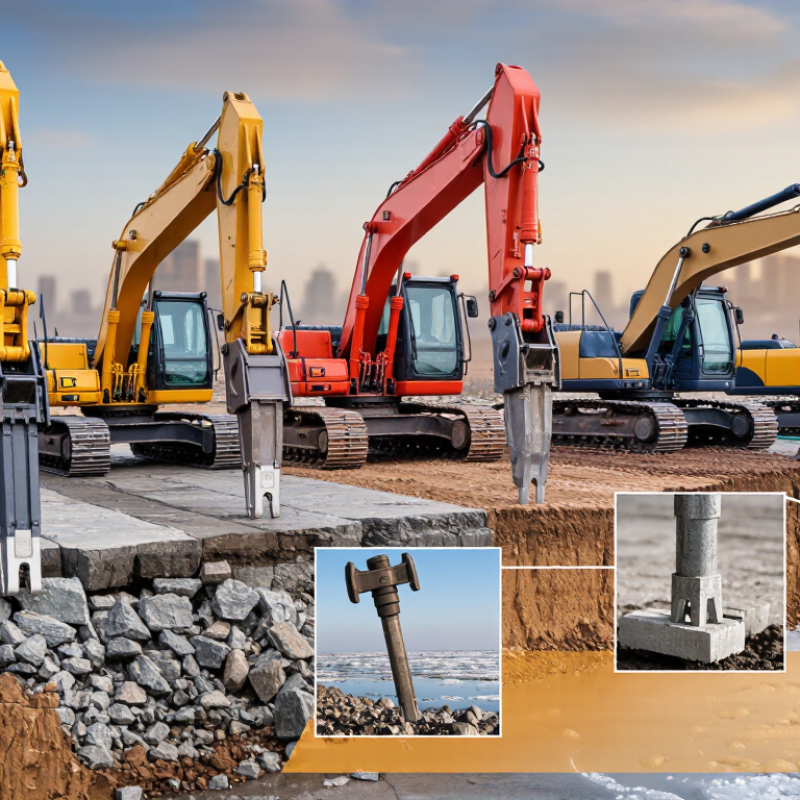
The best breaking hammer depends on the excavator job, not just impact power. Concrete demolition usually needs a pointed or moil tool for deep cracks. A blunt tool can work better on thin slabs and brittle masonry. For rock excavation, a heavy-duty hammer with strong energy transfer is often more suitable.
Match the hammer to the carrier’s operating weight, hydraulic flow, and pressure. A hammer running too fast can overheat the hydraulic oil. Too little flow may produce weak, irregular blows. Always check the excavator manual and hammer specifications before installation. The tool must also fit the material and working space. A compact hammer is easier to control in trenches or near walls. Large hammers can damage the boom when used on light excavators.
Operator experience matters. A sharp, even impact often indicates proper alignment. A dull thud may suggest poor contact, worn bushings, or incorrect pressure. Keep the tool straight against the surface. Do not pry with the hammer. Use short bursts on fragile structures, then inspect the crack pattern. Grease the tool regularly and check retaining pins during each shift.
Bigger is not always better. I once preferred maximum impact, but transport limits and restricted access proved that choice was impractical. That lesson still needs repeating. Job records, maintenance history, and actual site conditions should guide the final selection.

 +86 13794985240
 CONTACT NUMBER
 CONTACT NUMBER